
Seasonal
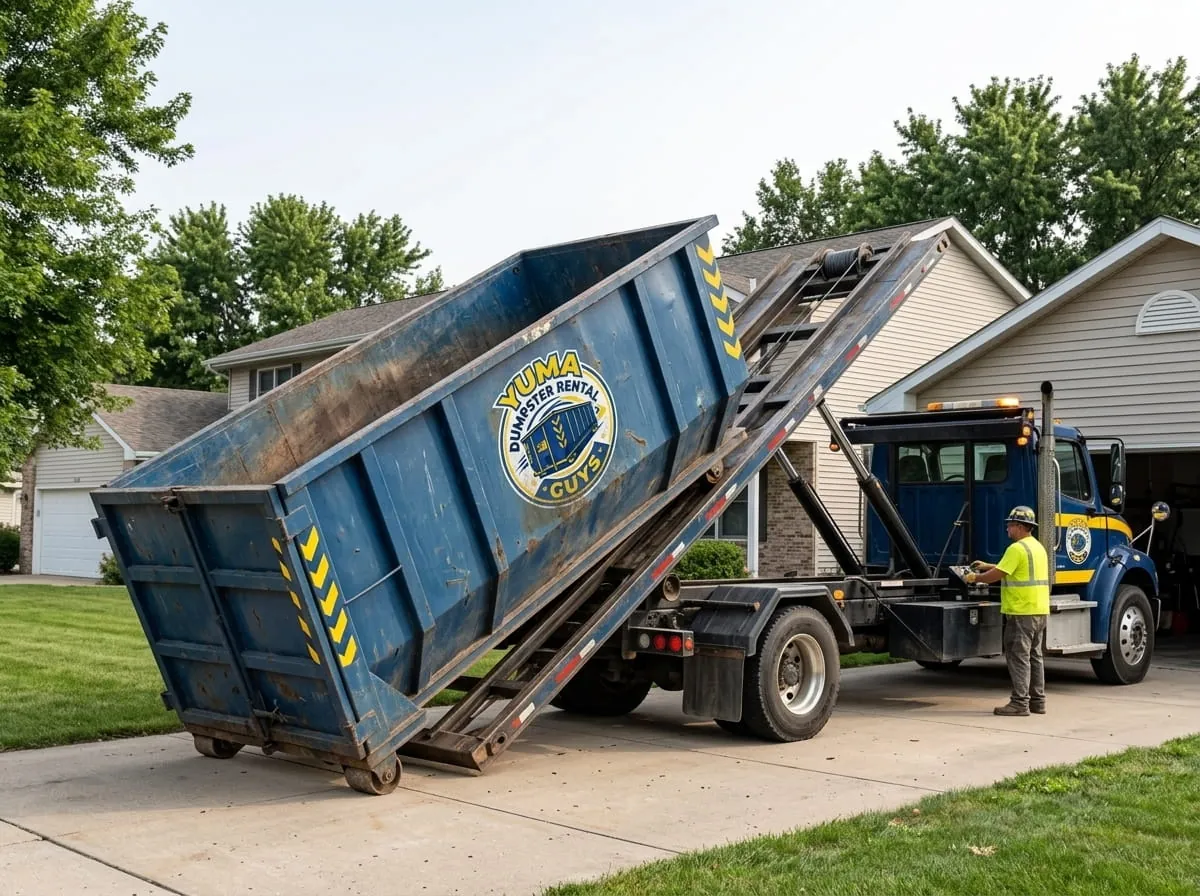
Loading a Container in a Yuma Summer
Heat is not a footnote to summer work here. It changes the schedule, the materials, the driveway and the people, and every one of those has a practical consequence.
⭐ The number that governs everything
Yuma receives more sunshine, as a percentage of the possible total, than anywhere else on earth. For long stretches of summer the daily high sits above a hundred and seven, and the record is well into the twenties above that. Annual rainfall is a little over three inches for the entire year.
People new to the area underestimate it in a specific way: they assume it is the same as a hot day elsewhere, only more so. It is not. A hot day elsewhere has a cool morning and a tolerable evening. A Yuma July has a night that does not drop far, a surface temperature on concrete and metal far above the air temperature, and a working window that closes hard by mid-morning.
Why the work moves to first light
Every experienced trade in this city starts early in summer, and it is not a preference.
By mid-morning, exposed surfaces — a roof, a driveway, the steel side of a container — are substantially hotter than the air. By early afternoon, productive outdoor work on a dark surface is genuinely unwise rather than merely unpleasant.
So the summer rhythm is: start at or before first light, do the heavy and exposed work in the first four or five hours, and move to shaded, indoor or light tasks after that. A demolition or roof tear-off that would take one long day in February takes two shorter mornings in July, and planning for that honestly is better than discovering it at eleven o'clock.
⚠️ The practical consequence for a container is delivery timing. If the loading window is five until ten in the morning, a container delivered at eleven has lost you a day. Say when you want to start, and we will set it the day before or at first light rather than at a convenient mid-morning slot.
⚠️ What the heat does to your driveway
This one surprises people who have moved here from cooler states, and it is worth a paragraph of its own.
Asphalt softens. An asphalt driveway in a Yuma afternoon is not the rigid surface it is in January. A loaded roll-off concentrates a great deal of weight onto a small number of contact points, and on hot asphalt those points can press in and leave permanent depressions.
The fix is the same one we use on sand, and we do it as standard: timber under the wheels and under the rails, spreading the load across a much larger area. On a hot asphalt drive we will use more of it, and we will favor a morning placement and a morning collection where the schedule allows.
Concrete is fine structurally, which is most driveways here. Boards still go down, because they also prevent the scuffing and staining that a steel container can leave on a light concrete surface.
Decomposed granite and gravel drives need boards for a different reason: the container will settle into them under load. That is covered in the sizing article.
Materials behave differently at these temperatures
Several things that are routine elsewhere are not routine here in summer.
Asphalt shingles soften considerably. A tear-off in the afternoon produces shingles that tear rather than lift, stick to each other in the container, and compact into a mass that is harder to tip out at the other end. Morning tear-offs are cleaner work and a cleaner load.
Adhesives, caulks and sealants have a working time that shortens dramatically. This matters less for disposal and a great deal for whoever is doing the installation side of the job.
Paint and solvent containers left in direct sun build pressure. They should not be in the container at all, but the more immediate point is that they should not be sitting in the sun in a staging pile either.
Anything aerosol is a straightforward hazard in a steel box in a Yuma summer. Keep it out.
Green waste decomposes fast. Grass clippings and soft green material in a closed container in August will begin to break down within a day or two, with the smell and the insects that implies. Green waste in summer wants a short rental and a prompt collection, not a leisurely one.
⭐ The container itself gets hot
A steel box sitting in full sun all day reaches a surface temperature well above the air temperature. Two practical consequences follow.
First, handling. The top rail, the door latch and the sides are genuinely hot enough to burn bare skin on a summer afternoon. Gloves, and not the thin ones.
Second, placement. If there is a choice between a spot in full sun and a spot that gets afternoon shade, take the shade — not for the steel's sake but for yours, because the work happens standing next to it.
Where there is no shade and the job runs several days, there is a case for a shorter rental with a swap rather than one long one, particularly for anything organic. A container is cooler and more pleasant to work with on day one than on day six.
⚠️ The human part, which is the serious part
Everything above is logistics. This part is not.
Heat illness is a real risk in this city every summer, and the people most at risk are the ones doing exactly the kind of work a container implies: repetitive lifting, outdoors, in the sun, often by someone doing it themselves at the weekend rather than a crew who do it daily and know their limits.
⚠️ Do not load a container through the middle of a Yuma summer afternoon. That is not caution for the sake of it. Carrying material to a box in direct sun at a hundred and ten degrees is genuinely dangerous, and it is dangerous before it feels dangerous.
If you are doing it yourself: start early, stop by mid-morning, drink more water than you think you need and keep drinking it, take breaks in shade rather than pushing through, and do not work alone on a big loading day. Loading is heavier work than it looks, and it is a bad combination with heat.
If something has to be done in the afternoon, make it the light, shaded or indoor part of the job and leave the carrying for the morning.
Sequencing a summer job so it works
A sensible summer sequence looks like this.
Container arrives the evening before or at first light. Not mid-morning.
Heavy, exposed work first. Tear-off, demolition, carrying, anything on a roof or in the open. First light to mid-morning.
Light and shaded work after. Sorting, interior strip-out, staging material under cover ready for the next morning's load.
Stage, do not carry, in the afternoon. Material can be moved into a shaded pile near the container in the afternoon and loaded first thing. That splits the effort sensibly.
Collection in the morning too, where it can be. Particularly on asphalt.
A job planned this way takes more calendar days and fewer miserable ones, and it finishes.
What we do differently from June to September
We shift deliveries earlier, and we say so rather than quietly booking you a mid-morning slot. We carry more timber in summer and use it on asphalt as a matter of course, not just on sand. We will recommend a shorter rental on green waste, because of what August does to it. And when someone describes a July tear-off as a one-day job, we will say honestly that it is probably two mornings.
None of that costs anything. It is simply what working in the sunniest city on earth actually requires, and we would rather build the schedule around it than pretend the heat is somebody else's problem.
Need a container in Yuma?
Call and describe the job. Three minutes on the phone gets you a size recommendation, a flat rate and a delivery window — and we will tell you if a smaller, cheaper container is the right answer.
Call (928) 248-1057