
Cleanouts
An Estate Cleanout, Room by Room
Clearing a family property is slow, emotional work with a hard logistical core. An order of work makes it manageable, and there are two Yuma-specific traps worth knowing about first.
Before anything is moved
Estate work is different from every other kind of clearance, because the logistics are the easy part.
Three things are worth settling before a single box is lifted.
Authority. Make sure the person directing the clearance has the standing to do it. If an estate is going through probate, or there are several beneficiaries, agreeing who decides — in writing — prevents the worst kind of argument, which is the one that happens after the container has gone.
A walk-through first. Walk every room, every closet, the garage, the attic and any outbuilding before you book anything. You are looking for three things: documents, anything that looks valuable, and anything hazardous.
Documents and photographs out first. Deeds, titles, insurance papers, financial records, military records, letters and photographs. Put them in one box and take that box out of the house before general clearing starts. Paper is the thing that gets thrown away by accident and cannot be recovered.
⭐ The two places the volume actually hides
Everywhere has this problem, but the Yuma version is specific, and it is worth knowing before you size anything.
There are no basements here. Properties in this region are slab-on-grade, essentially without exception. In much of the country a cleanout's hidden volume is in the cellar; here it is not, because there isn't one.
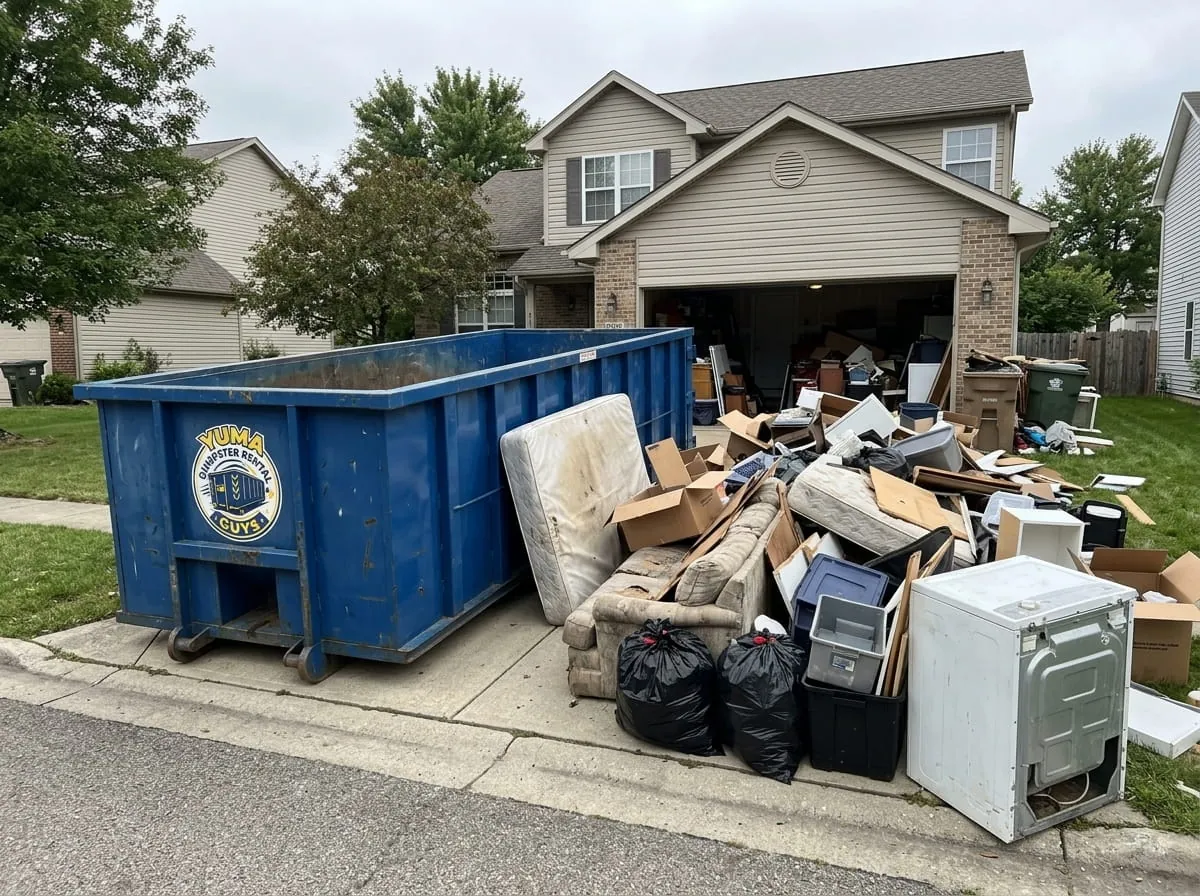
A two-car garage used for storage rather than cars holds an extraordinary amount, and because it is at ground level people mentally discount it — it looks like a room rather than a store. Attics here are often large, often floored, and reached by a pull-down ladder that nobody has climbed in a decade.
⚠️ Walk both before you estimate. A clearance that looks like a 20 yard from the living space is routinely a 30 once the garage is opened, and the attic is frequently the thing that adds the second load.
The third place, on a county or valley property, is the outbuilding — a shed, a shop, a carport store. Same rule: open it before you estimate.
An order of work that holds up
Work from the least emotional to the most, and from the largest volume to the smallest.
1. Documents and valuables out. As above. Before anything else.
2. The hazardous sort. Walk the property with a box and pull everything chemical, pressurized or battery-powered. Garage and shed mostly. Do this early, because it is the one category that cannot be fixed later.
3. The garage. Start here. It is the biggest volume, it is the least emotionally loaded, and clearing it gives you staging space for everything else.
4. Outbuildings and yard. Same reasoning.
5. Kitchen, bathrooms, laundry. Functional rooms. Decisions are easy and volume is real.
6. Living areas and bedrooms. Furniture out first, then contents.
7. The attic. Late, because it is awkward and because by now you have room to sort underneath it.
8. Personal rooms and keepsakes. Last, deliberately, and not on the same day as anything else if you can help it.
The reason for this order is practical and it is also kind. By the time you reach the hardest rooms you have had a week of practice at deciding, and the house has space to sort in.
⚠️ Sorting into five streams, not two
Most people sort into keep and throw. Five streams is barely more work and it changes what the job costs.
Keep. Out of the house, into a vehicle or a labelled corner, immediately.
Sell. Furniture, tools, collectables, appliances that work.
Donate. Clothing, household goods, books, usable furniture.
Scrap metal. Appliances, bed frames, tools, pipe, wire, the swamp cooler. ⚠️ This stream matters more than people realize: metal is the heaviest ordinary thing in a house, and taking it out of the container reduces the load weight more than any other single decision.
Container. Everything else.
Keep the five streams physically separate from the start. Re-sorting a mixed pile is the single most wasted effort in a cleanout.
⭐ What is worth more than it looks
In a hurry, these go in the container and should not.
Tools. Hand tools and older power tools from a generation that bought them to last. Frequently the most valuable thing in the garage.
Solid wood furniture. Even damaged, and even unfashionable.
Appliances that work. Donation or resale, and scrap if not.
Anything military. This is a military town, with the Proving Ground and the air station both here. Service records, insignia, photographs and equipment have both family and collector value, and they are easy to lose in a general clearance.
Books, records and photographs. Slow to sort, occasionally valuable, and impossible to recover once buried.
Jewelry and coins in unexpected places. Check containers, drawers, pockets and boxes before they go. It is not a myth.
⚠️ The hazardous material, and where it goes
Every long-occupied property accumulates the prohibited list, and a garage in this region accumulates a particular version of it.
Paint and solvent, pesticides and weedkiller, pool and spa chemicals, motor oil and automotive fluids, propane cylinders, batteries of every kind, old aerosols and pharmaceuticals. The City of Yuma household hazardous waste site at 155 West 14th Street is the route, along with the city's periodic household hazardous waste events.
⚠️ Two that catch people specifically. Refrigerators, freezers and air conditioning units hold refrigerant that must be recovered by a qualified technician before the shell can be scrapped — and an old property often has a spare fridge in the garage that everybody forgot about. Propane cylinders accumulate quietly and must be exchanged or returned, never put in a container.
If the property is older and you encounter anything that might be asbestos — older insulation, certain floor tiles and their adhesive — stop and have it tested. It is regulated, it is not a container item, and it is not worth guessing about.
Sizing the container for a full property
For an ordinary three-bedroom Yuma home with the contents of a long occupancy, a 20 yard is the starting point and a 30 yard is the realistic answer once the garage and attic are included.
Go to a 30, or plan a swap, if there are outbuildings, a workshop, a garage that has not been used for a car in twenty years, or a property on a larger county lot.
⚠️ Keep the heavy material out of the house load. Rock, pavers, concrete and soil from the yard are a separate small container, for all the reasons covered in the sizing article. A house clearance is bulky and light; mixing yard hardscape into it wastes the capacity you are paying for and risks an overweight load.
If the clearance will run over more than a week or two, a swap is usually better than one very long rental — it keeps the container accessible and stops it becoming a neighborhood amenity.
Doing it from out of state
A great deal of estate work here is arranged by family who live elsewhere, and it works perfectly well with a few things settled in advance.
Agree the placement precisely, with a photograph of the spot. Agree access — who has keys, whether there is a gate or an HOA, and whether anyone needs to be on site. Name one person who can authorize a swap or a second container without a conference call. Set a firm collection date rather than leaving it open-ended.
And if you are coming in to do the work yourself in summer, plan it around the heat rather than against it: load at first light, stage material in shade through the afternoon, and give the job more days than you think it needs. A cleanout is heavy work, and doing it in a Yuma July while also grieving is not a combination to rush.
Need a container in Yuma?
Call and describe the job. Three minutes on the phone gets you a size recommendation, a flat rate and a delivery window — and we will tell you if a smaller, cheaper container is the right answer.
Call (928) 248-1057