
Seasonal
When Yuma Empties Out: The Spring Cleanout Wave
Between November and March this city roughly doubles in size. What happens in the few weeks when it empties again is the most distinctive piece of work in the Yuma calendar.
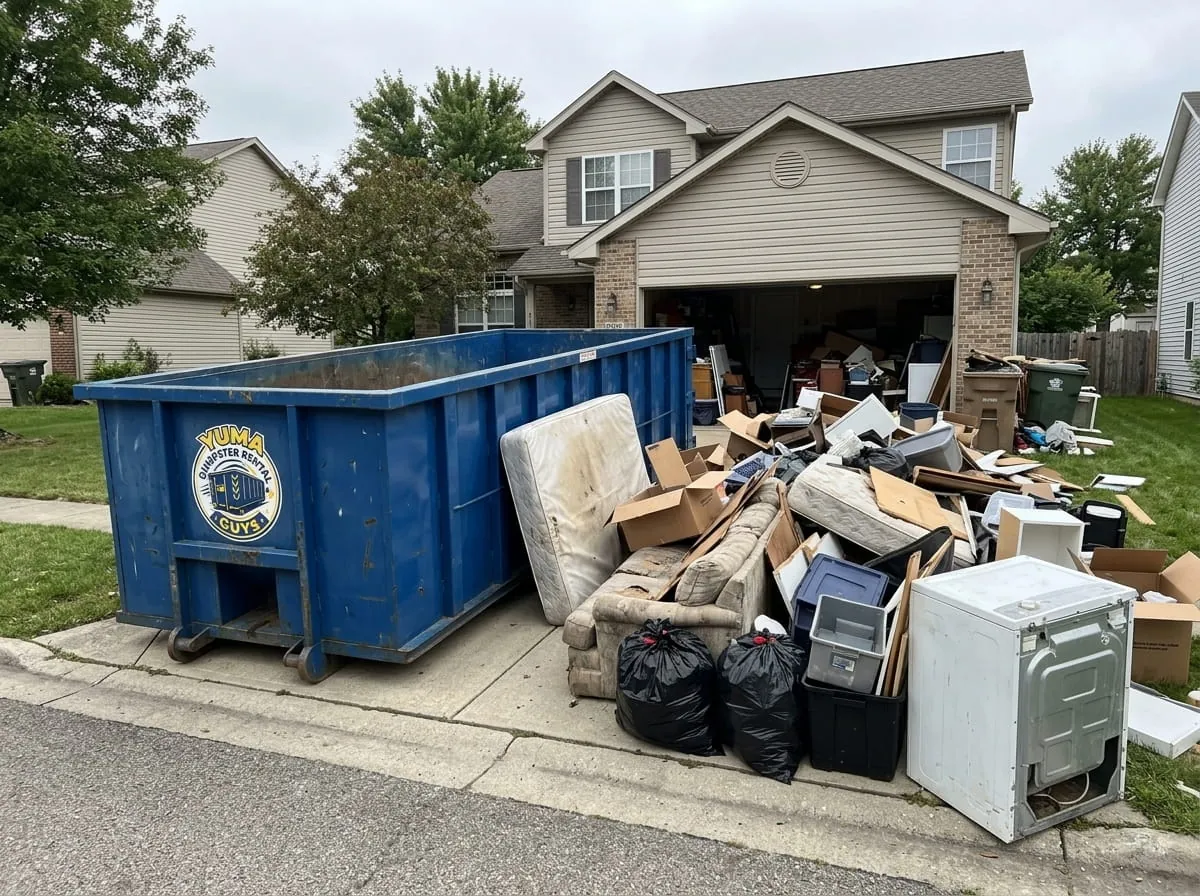
⭐ A city that doubles and then empties
There is no polite way to describe the Yuma calendar other than seasonally. From roughly November the winter visitors arrive, the RV and park model communities fill, traffic on the Foothills corridor changes character, and the metro population swells enormously. From roughly March it reverses, and a great deal of it happens in a handful of weeks.
The consequence for container work is specific. A large volume of cleanout demand — park models being sold or handed back, lots being cleared, properties being closed up or emptied permanently — arrives inside a short, predictable window, from people who in many cases are leaving the state within days of the work being finished.
That is a different job from an ordinary household cleanout, and it is worth treating differently.
What a park model cleanout actually involves
A park model or seasonal lot clearance is not a small house clearance scaled down. The mix is its own thing.
There is usually a structure element: an Arizona room, a carport, a shed, a deck, an awning or a skirting that has reached the end of its life and is coming off. That is framing, panel, roofing material and fixings, and it is bulkier than it sounds.
There is a contents element: furniture that was bought for the lot and is not worth moving, outdoor furniture that has had a decade of this sun on it, appliances, bedding, kitchenware, and the accumulated contents of every storage space on the lot.
There is almost always a yard element: gravel, pavers, planters, shade structures, artificial turf, and whatever has been built up around the lot over the years.
And there is a disposal problem element, which is the one that causes trouble: propane cylinders, batteries, paint, solvents, pool and spa chemicals, and in some cases a small generator or an air conditioning unit. None of those can go in the container, and more on that below.
⚠️ The compressed window, and why it matters
The practical difficulty of the spring wave is not the work. It is that an unusual number of people need the same thing in the same three or four weeks, and most of them have a departure date.
⚠️ That means the thing that goes wrong is scheduling, not sizing. A container booked two days before a flight, on a job that turns out to need two loads, is a genuinely bad position to be in — because the second haul has to happen whether or not you are still in the state to supervise it.
Three things make it go smoothly:
Book earlier than feels necessary. A week of notice in February is easy. The same request in the third week of March is competing with a great many others.
Assume a second load is possible. If there is any chance of it, say so when you book, so the swap is already in the schedule rather than being added to a full week.
Leave a day of margin before you go. Not because we expect to need it, but because a cleanout that uncovers more than expected is extremely common, and a day of slack converts a crisis into an inconvenience.
Sizing a seasonal lot clearance
Most park model and RV lot clearances land on a 20 yard. The contents are bulky and light, the structures are bulky and light, and volume rather than weight is the limit.
Step up to a 30 yard if an Arizona room, a large deck or a substantial carport is coming off, or if the lot has a shed that has been quietly filling for fifteen years.
Step down to a 15 yard for a straight contents clearance with no structure attached — furniture, kitchen, soft furnishings and the storage spaces, but the building staying as it is.
⚠️ The exception, and it is a real one here: if the lot has gravel, pavers or rock coming out as part of the clearance, that is a separate problem. It is dense enough to hit a weight limit in a small container, and it is much better run as its own load than mixed into a general clearance. The sizing article covers why in detail.
⭐ The things that are worth keeping back
A spring clearance moves fast and a great deal of usable material ends up in a container because there was no time to think about it. Some of it is worth two minutes.
Appliances and white goods. Working units have a resale or donation route, and even non-working ones are scrap metal rather than landfill. Metal is the heaviest ordinary thing in a clearance, so taking it out helps the weight as well.
Outdoor furniture that has survived. Yuma sun destroys most of it, but frames often outlast fabric and are worth more than they look.
Tools and hardware. Accumulated over years of lot maintenance, frequently better than anything the next owner will buy.
Anything a neighbor on the row will take. In seasonal communities this is a genuine disposal route, and the social network for it is already there.
None of this is moralizing about waste. Every item that leaves by another route is volume and weight you are not paying to bury.
⚠️ What cannot go in, and it comes up every time
Seasonal lots accumulate exactly the categories that a container cannot take.
Propane cylinders. Every lot has them, often several, and they absolutely cannot go in. Pressurized vessels are a serious hazard in a compactor or a landfill face. Exchange or return them.
Paint, solvent, pool and spa chemicals. The City of Yuma operates a household hazardous waste site at 155 West 14th Street and runs periodic household hazardous waste events. That is the route.
Batteries. Vehicle, deep-cycle and household. All have their own handling.
Electronics. Televisions and monitors in particular.
Air conditioning units and anything with refrigerant. Refrigerant has to be recovered by someone qualified before the shell can be scrapped. This one catches people out constantly, because the unit looks like plain metal.
Tires. Handled separately, and the landfill segregates them.
When the owner is not here to supervise
A good share of this work is arranged remotely — by an owner who has already left, by a family member, by a park manager, or by a realtor preparing a lot for sale. That is routine and it works, provided a few things are settled in advance.
Agree the placement before delivery, precisely: which part of the lot, which approach, and whether anything overhead is in the way. A photograph of the spot removes all doubt.
Agree who has access and whether a gate, a code or a park office is involved. Seasonal communities often have controlled entry and quiet hours, and both affect when a truck can come.
Agree what happens if it needs a second load, in advance, including who authorizes it.
Agree the collection date rather than leaving it open. An unattended container with an open end date tends to acquire other people's material, which is a problem for whoever is paying for it.
Planning it so it is not a scramble
The spring wave is predictable, which means it is manageable. The owners who find it easy do three things: they decide in January rather than March, they separate the hazardous material early, and they book with enough margin that a surprise in a shed does not become a missed flight.
If you are clearing a lot this season, call and describe it — the structure, the contents, the yard, and your departure date. That last one is not a detail. It is the constraint everything else has to fit around, and knowing it up front is the difference between a scheduled job and a scramble.
Need a container in Yuma?
Call and describe the job. Three minutes on the phone gets you a size recommendation, a flat rate and a delivery window — and we will tell you if a smaller, cheaper container is the right answer.
Call (928) 248-1057