
Pricing
What a Dumpster Actually Costs in Yuma
Yuma County does not publish a public tipping rate and the landfill is privately run, so anyone quoting you a precise per-ton figure online is guessing. Here is what genuinely moves the price.
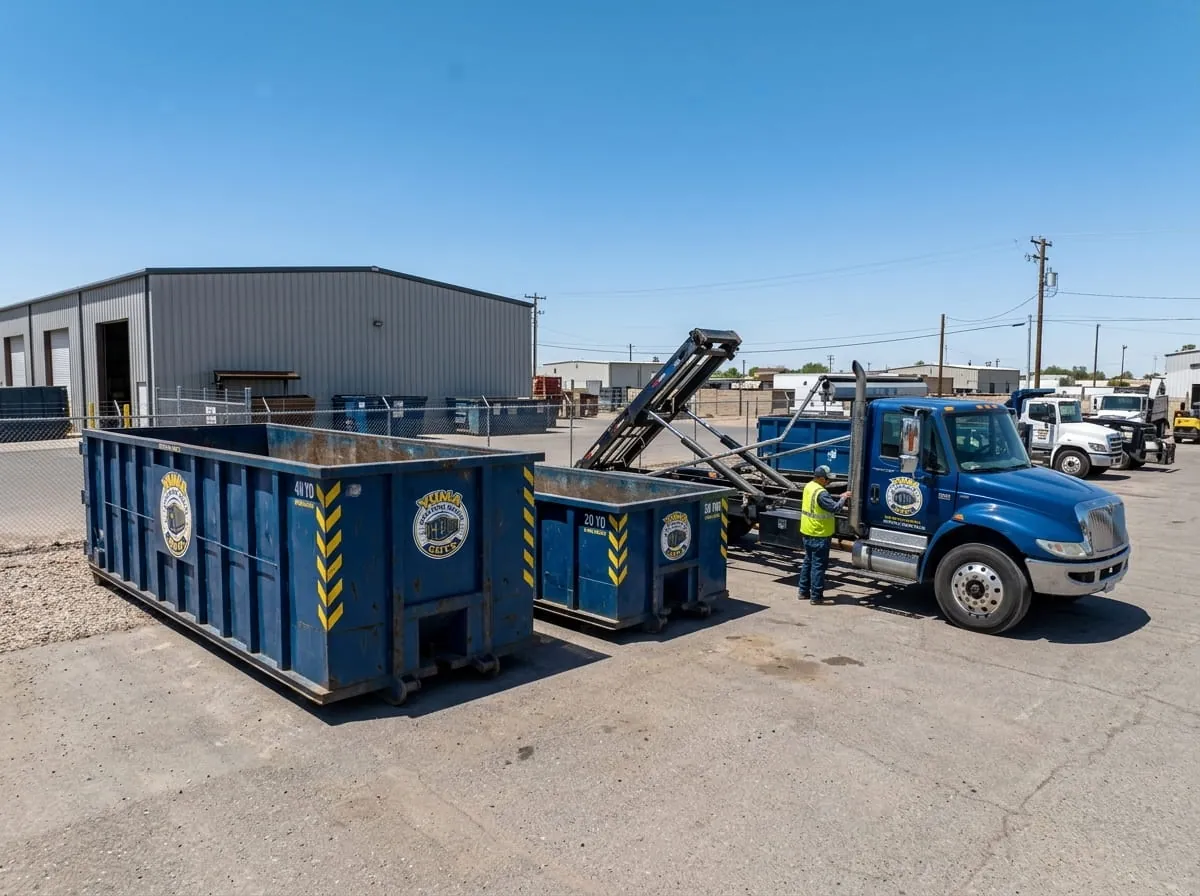
Why there is no published rate to look up
In some parts of the country the county runs the landfill and publishes a price list, so you can look up what a ton of concrete costs to bury before you book anything. That is not how it works here, and it is worth understanding why.
A private landfill does not publish a public rate sheet, and it is not obliged to. So any website that tells you a Yuma roll-off costs exactly a given number, or quotes you a precise per-ton disposal figure without knowing your material, is working from a national average rather than from anything local.
We would rather tell you what drives the price and then quote your actual job than publish a number that turns out to be wrong for you.
⭐ What is actually inside a quote
A roll-off quote anywhere in the country is made of the same five things:
The haul. Getting a truck and an empty container to you, and getting the full one back out again. Two trips, fuel, and a driver's time.
The disposal. What the landfill charges to take the material, by weight, which is the part that varies most with what you are throwing away.
The rental period. The container is an asset sitting on your driveway rather than earning on someone else's. Standard periods are generous; overstays are chargeable.
The container itself. Maintenance, repainting, replacing the ones that get damaged.
The overhead. Insurance, permits, licensing, the person who answers the phone.
When a quote looks unusually cheap, one of those five has been left out of the headline and will appear later. The usual candidate is disposal, which is why some quotes include a tonnage allowance and some do not.
⚠️ The four things that move the number
Size. Obvious, and the smallest factor of the four. The difference between a 15 and a 20 is real but modest.
Material. Much bigger. Clean concrete, clean green waste, mixed construction debris and general household waste are not the same thing to dispose of, and a mixed load is the expensive one.
Weight. Bigger still, and covered in its own section below.
Duration. Modest, until it is not. A container that sits for three weeks on a job that quoted a week has a real cost attached.
⚠️ The thing that catches people is that these interact. A 30 yard container of mixed heavy debris kept for a month is not twice the price of a 15 yard of clean green waste for a week. It is several times.
Weight is the one that surprises people
Disposal is charged by weight, and Yuma has a particular talent for producing heavy loads that do not look heavy.
Decomposed granite and landscape rock are the obvious case. A cubic yard of it is roughly a ton and a quarter to a ton and a half. Pulling the rock out of a modest front yard can be several tons of material from an area you could walk across in six paces.
Concrete tile roofing is the second. A square of concrete tile is several times the weight of a square of asphalt shingle, so the same roof area produces a far heavier load.
Irrigated valley soil is the third, and the least expected. Soil from the Yuma Valley, Gadsden or the North Gila Valley that has been through a watering is substantially heavier than the same soil dry. Timing a soil job a few days after an irrigation rather than a few days before genuinely changes what it weighs.
The distance question, answered honestly
We serve the whole county, from Donovan Estates ten minutes out to Dateland an hour east. People reasonably assume the far end costs more.
It does not, in our pricing. We quote the container and the material, not the mileage. What distance actually changes is scheduling, and we would rather be straight about that than pretend otherwise. Fortuna Foothills, Yuma Mesa and the valley communities are routine same-day. Wellton and Ligurta we run regularly. Tacna and Dateland we schedule rather than promise, because forty-five minutes to an hour each way has to fit a route.
If someone quotes you a long-distance surcharge out to Wellton, that is a business decision rather than a law of physics. If someone promises you a same-day container in Dateland without checking a schedule, treat that with the suspicion it deserves.
⭐ How to spend less without cutting corners
Separate the heavy material. Clean concrete, clean masonry and clean green waste are cheaper to dispose of than the same material mixed into general debris. If a job produces a worthwhile quantity of one of them, running it as its own load usually pays for itself.
Right-size rather than over-size. A container you half fill still costs what it costs. Two accurate loads often beat one oversized one, and on heavy material they are the only option anyway.
Use the city's own services for what they cover. The City of Yuma runs an annual Neighborhood Clean Up Campaign and periodic household hazardous waste events, and collects a weekly ninety-gallon refuse and ninety-gallon recycling container from city addresses. For the slow accumulation of ordinary household material, that is free and it is already paid for. A roll-off is for the jobs that outrun it.
Keep the banned material out. A load that arrives with paint, solvent, batteries or electronics in it can be rejected or surcharged. Those have their own route, and using it is cheaper than not.
Be realistic about the period. If the job will genuinely take three weeks, book three weeks. An extension negotiated in advance is cheaper than an overstay discovered afterwards.
⚠️ Charges that should never be a surprise
A fair quote tells you about these before you book, not after:
Overweight. What the included tonnage is, and what each ton over it costs.
Overstay. What the rental period is, and the daily rate past it.
Contamination. What happens if prohibited material turns up in the load.
Dry run. What happens if the truck arrives and cannot place or collect — blocked access, a car in the way, a container heaped above the rail.
Relocation. What it costs to move a container once it is set.
None of those are unreasonable charges. All of them are unreasonable surprises. Ask about all five and you will learn more about a company from how readily it answers than from the numbers themselves.
What to ask when you call
Four questions get you a quote you can rely on. What is included in the price. What the tonnage allowance is and the rate beyond it. How long the rental period runs and what an extra day costs. And what happens if the load has something in it that should not be there.
Then describe your material honestly, including the parts you suspect are heavy. A quote built on an accurate description is a quote that still looks the same when the invoice arrives, which is the only test of pricing that actually matters.
Need a container in Yuma?
Call and describe the job. Three minutes on the phone gets you a size recommendation, a flat rate and a delivery window — and we will tell you if a smaller, cheaper container is the right answer.
Call (928) 248-1057