
Construction
Debris on a Build: Phases, Sizes and Site Placement
Construction waste arrives in phases, and each phase has a different density. Matching the container to the phase beats parking one big box on site for the duration.
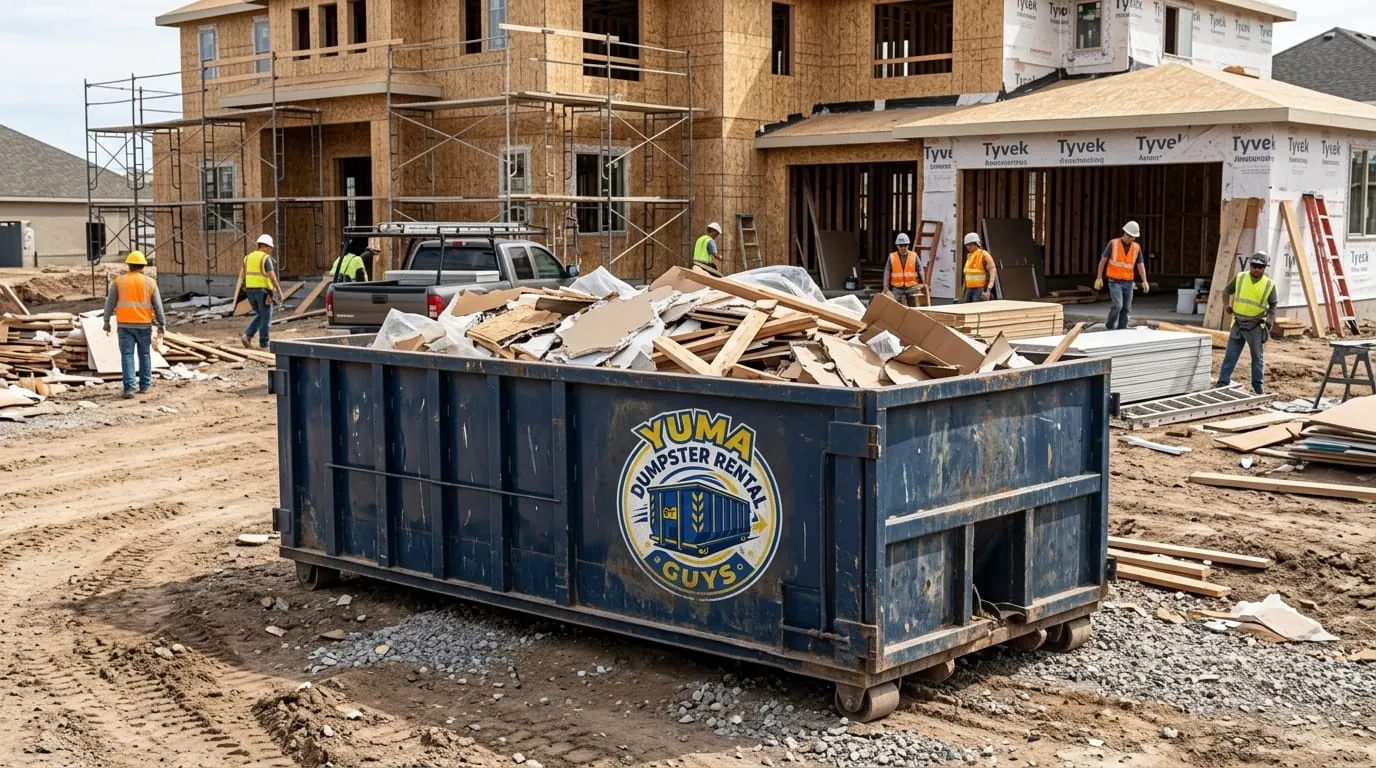
⭐ Debris arrives in phases, not all at once
The default approach on a build is to put one large container on site at the start and let everyone throw everything in it until it goes. It works, and it is almost always the most expensive option.
Matching the box to the phase costs no more in delivery and frequently costs considerably less in disposal, because each load is closer to a single material and because nothing is sitting half empty while the weight limit is reached by something else.
The demolition and sitework phase
If there is anything to come out first — an existing structure, a slab, a driveway, a block wall, a yard full of rock — this is the heavy phase and it should be its own container.
Concrete, block, masonry, tile, pavers and decomposed granite are all dense. On a Yuma site the rock is frequently the single heaviest item, because so many lots are landscaped in it.
⚠️ This is a 10 yard container, part-filled, and often several loads. It is also the phase where keeping the material clean genuinely pays: clean concrete and masonry dispose more cheaply than the same material mixed with timber, packaging and general debris.
Valley sites add one more consideration. Irrigated ground out through Somerton, Gadsden and the North Gila Valley holds water, and soil excavated days after a watering is substantially heavier than the same soil dry. Where a schedule allows any flexibility at all, that is worth an eye.
Framing and shell: the bulky middle
Framing, sheathing, roofing and the shell produce the classic construction mix: timber offcuts, panel, packaging, banding, broken sheet material, roofing waste and a great deal of cardboard.
This is bulky and moderately light, which makes it a 30 yard phase. Volume is the limit and the container will fill to the rail long before weight becomes an issue.
Two things worth doing. Break down cardboard — packaging is an enormous proportion of shell-phase volume and flattened boxes take a fraction of the room. And keep clean timber separate if there is enough of it to be worth a stream of its own; on a larger build there often is.
Roofing in this phase follows the rules in the roofing article: concrete tile is heavy enough to want its own small container, foam and shingle go in with the general shell waste.
⚠️ Finishes: light, messy and endless
The finishing phase produces the least weight and causes the most trouble.
Drywall offcuts and dust, flooring waste, trim, paint packaging, tile and tile backing, fixture boxes, insulation scrap, and an extraordinary quantity of wrapping. It is light, it is bulky, and it arrives steadily over weeks rather than in a burst.
A 20 yard usually covers it, but the characteristic problem is duration rather than size: the finishing phase runs long, and a container that sits for six weeks on a residential street is a different proposition from one that sits for four days.
⚠️ It is also the phase where prohibited material appears. Paint, solvent, adhesive, caulk tubes and aerosols all belong to finishing trades, and they all belong on the hazardous route rather than in the box. Make that clear to everyone on site rather than assuming, because a contaminated load is a cost that lands on whoever booked the container.
⭐ Matching container to phase
Put together, a straightforward build looks like this:
Demolition and sitework: 10 yard, part-filled, as many loads as the material needs. Keep concrete and masonry clean.
Framing and shell: 30 yard, filled to the rail. Break down cardboard.
Roofing, if tile: its own 10 yard. If foam or shingle, it goes in with the shell.
Finishes: 20 yard, with a swap if the phase runs long.
Final clean: 10 or 15 yard. There is always more than anyone expects at the end.
On a small remodel these collapse sensibly into one or two containers. On anything larger, running them as phases is both cheaper and tidier.
Site placement on an active build
A container on a working site has to be reachable by the truck without the site being shut down to make it happen.
Put it where the truck can approach straight and leave straight, with nothing overhead. Vertical clearance is the one people forget, and on a build it is often a newly run service line or the structure itself.
Keep it close to the work but out of the delivery path for materials coming in. A container positioned where the lumber truck needs to be is a container that gets worked around badly for a month.
On unpaved and partly built sites, timber under the wheels as standard. On an existing asphalt drive in summer, more of it, for the reasons in the heat article.
And if the site is inside the City of Yuma and the container has to occupy the street rather than the lot, that is an encroachment permit from the City Engineering Department with a traffic control plan cover sheet, and it is not a same-day item. In unincorporated county — which is most of the Foothills and valley — it is the county's own permit, and on a county lot it rarely arises at all.
⚠️ Keeping the site tidy in a wind
Yuma gets wind, and a construction container is full of exactly the material that travels: packaging, wrapping, insulation scrap, cardboard, sheet offcuts.
Load heavy material over light where you can, so the light material is held down rather than sitting on top waiting to leave. Break down and stack cardboard rather than tossing it in loose. And if the container is going to stand over a windy afternoon with light waste near the top, it is worth the two minutes to weight it down.
This is not a tidiness point. Material that leaves a container is material the site is responsible for, and on a residential street it is the thing the neighbors remember about the build.
Commercial and multi-unit work
Larger jobs change the arithmetic rather than the principles.
On a multi-unit or commercial project the phases overlap — one block is framing while another is finishing — so running two containers of different sizes concurrently often beats one large one, for the same density reason as before.
Scheduled swaps beat call-when-full on anything with a program to hold. A container that is full on Thursday afternoon and collected on Monday is three days of material stacked beside it on the ground.
And it is worth nominating one person on site who owns the container: what goes in it, when it gets swapped, and who to call. On the jobs where that is clear, contamination and overfill essentially stop happening. On the jobs where everyone owns it, nobody does.
Need a container in Yuma?
Call and describe the job. Three minutes on the phone gets you a size recommendation, a flat rate and a delivery window — and we will tell you if a smaller, cheaper container is the right answer.
Call (928) 248-1057