Materials
What Can and Cannot Go in a Dumpster Here
Almost everything from a house or a job site goes straight in. The short list that does not has a proper route, and using it is cheaper than not.
The good news first
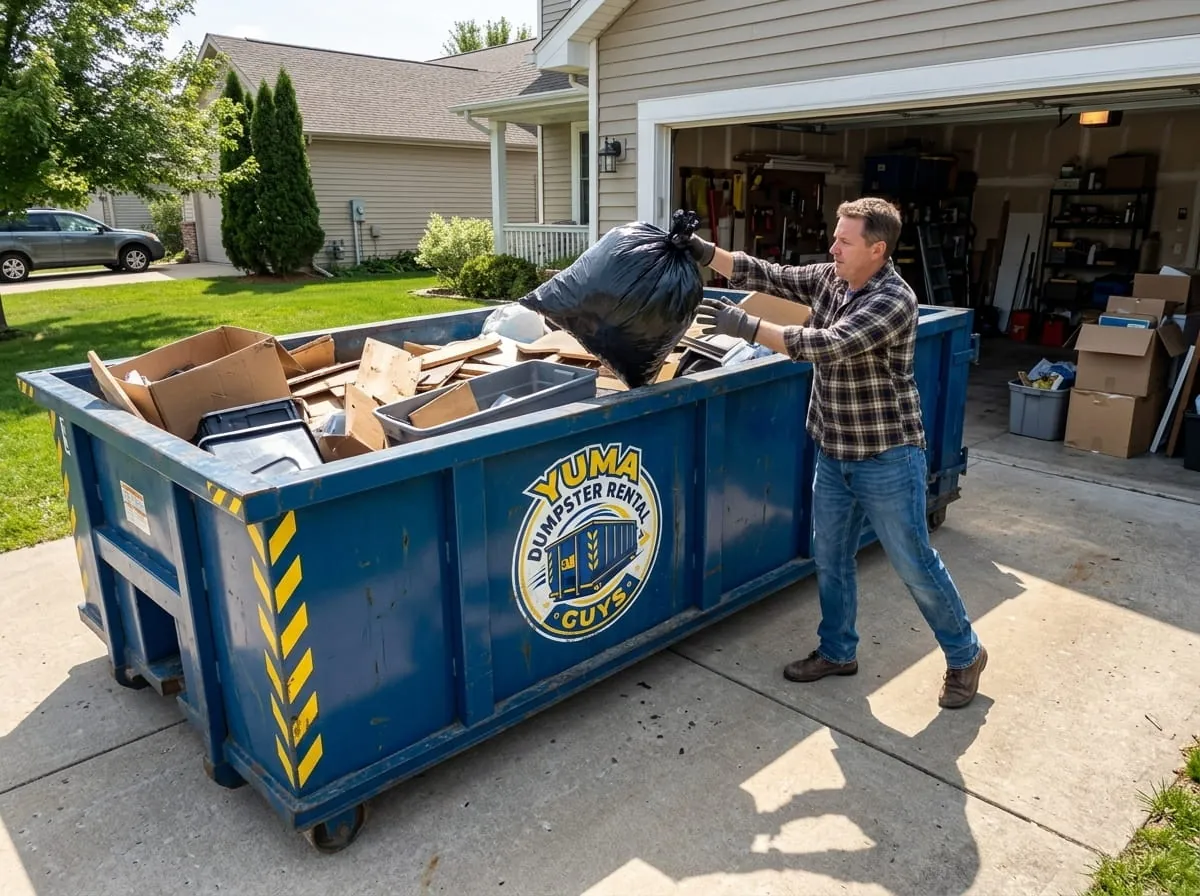
The overwhelming majority of what comes out of a house, a remodel or a job site goes straight into a roll-off with no thought required.
Furniture, carpet, flooring, drywall, timber, cabinets, counters, doors, windows, fixtures, roofing, siding, insulation, packaging, general household clutter, toys, clothing, garden furniture, non-hazardous renovation debris and ordinary yard waste are all fine.
The prohibited list is genuinely short. It is worth knowing properly, because every item on it has a sensible route and the routes are mostly free.
⚠️ The prohibited list, and why each one is on it
Paint, stain, solvent and thinner. Liquid, flammable and a contamination risk. Fully dried latex paint is a different matter — see below.
Motor oil, antifreeze, fuel, brake and transmission fluid. All of it.
Pesticides, herbicides, pool and spa chemicals. Common in this market and genuinely hazardous when mixed.
Batteries. Vehicle, deep-cycle, lithium and household. Lithium cells in particular are a serious fire risk once crushed.
Propane cylinders and any pressurized vessel. Non-negotiable. They explode.
Aerosols. Same reason, smaller scale, and a real hazard in a steel box in a Yuma summer.
Tires. Handled and segregated separately everywhere.
Appliances containing refrigerant — refrigerators, freezers, air conditioning units, window units. The refrigerant has to be recovered by someone qualified first. ⚠️ This is the one people miss, because the unit looks like plain scrap metal.
Electronics. Televisions and monitors especially.
Asbestos. Regulated, and handled by licensed contractors on a separate route. If you are working on an older property and you suspect it, stop and get it tested.
Medical waste, sharps and pharmaceuticals.
Anything still wet, running or leaking.
⭐ Where each banned item actually goes in Yuma
This is the part most articles skip, and it is the part that is actually useful.
Household hazardous waste — paint, solvent, pesticide, pool chemicals, automotive fluids. The City of Yuma operates a household hazardous waste site at 155 West 14th Street, and the city also runs periodic household hazardous waste events. That is the route for all of it.
Propane cylinders. Exchange them where you bought them, or return them to a dealer. Never in the container and never in the staging pile.
Tires. Copper Mountain Landfill accepts and segregates tires, and tire dealers generally take them back on replacement.
Appliances with refrigerant. Have the refrigerant recovered by a qualified technician. Once the unit is certified clear, the shell is scrap metal and goes the way all scrap metal does.
Scrap metal generally. A scrap yard, and it is the heaviest ordinary material in a clearance, so pulling it out helps the weight of your load as well.
Electronics. Keep them aside for an electronics collection rather than burying them.
Dried latex paint. If it is fully dried — hardened solid, not merely skinned over — it is generally treated as ordinary solid waste. Leaving the lid off in a Yuma summer dries a part can remarkably quickly, which is one advantage of the climate. Oil-based paint is hazardous waste regardless of how dry it looks.
What Arizona adds to the national rules
The prohibited list above is largely universal. Arizona's own framework sits on top of it rather than replacing it.
Solid waste in this state is regulated by the Arizona Department of Environmental Quality, which is the agency that permits landfills and transfer stations and publishes the list of them. The practical consequences for a householder are modest: the facilities you use are state-permitted, the hazardous categories above are the ones a permitted facility will not accept, and asbestos in particular is handled under its own rules.
What matters more here is local structure rather than state law. Yuma County runs the rural transfer stations — North Gila Valley on East County 5th Street, Wellton on Avenue 29E, Tacna, Dateland, and the South Transfer Station that opened in 2025 to serve the San Luis and Somerton end of the county. Those are for residents hauling their own material. The landfill itself, Copper Mountain out near Wellton, is privately operated and takes construction and demolition debris, household waste, green waste, white goods and segregated tires.
So the chain is: your container goes to a private landfill; your own small loads can go to a county transfer station; and your hazardous material goes to the city.
⭐ Materials that are allowed but want their own load
Allowed is not the same as sensible to mix.
Clean concrete, block, brick and masonry. Allowed, and cheaper to dispose of when it is clean and on its own. Mixed into general debris it loses that.
Clean green waste. Same logic.
Landscape rock and decomposed granite. Allowed, but so heavy that it needs its own small container regardless of cost.
Roofing. A clean tear-off load is straightforward. The same load with the fascia, the packaging and the old swamp cooler in it is not.
Soil. Heavy, and heavier again after an irrigation in the valley.
⚠️ The ones people get wrong most often
Air conditioning units. The single most common mistake in this market, for obvious reasons. A window unit or a condenser looks exactly like scrap metal. It is not, until the refrigerant is out.
Propane from an RV lot. Seasonal properties accumulate cylinders and they go in by accident during a rushed clearance.
Half-used pool chemicals. Very common here, genuinely hazardous, and dangerous to mix with anything else in the pile.
Weed fabric in a green load. It comes out of the ground with the plants and quietly contaminates an otherwise clean load.
“Nearly empty” paint cans. Nearly empty is not empty.
Televisions. Old sets are bulky, people are glad to be rid of them, and they are exactly what cannot go in.
What happens if something banned turns up
Depending on what it is and when it is noticed: the driver may decline to take the load until it is removed, the facility may charge a contamination fee that is passed on, or in the case of something genuinely hazardous the whole load may have to be handled differently at real cost.
None of that is punitive. A landfill that accepts a propane cylinder into a working face has a serious problem, and the charges exist because sorting someone else's mistake is expensive.
⚠️ If you are not sure about something, ask before it goes in. A thirty-second phone call is free and every outcome above is not.
A two-minute sort that saves money
Before the container arrives, walk the job with two boxes and a plan.
Box one: anything liquid, chemical, pressurized or battery-powered. That is the city hazardous waste run. Box two: electronics. Then set aside the scrap metal, the tires and anything with refrigerant in it as three separate piles.
What remains is the container load, and it will go in without anyone having to think about it again. On a seasonal lot or an estate clearance that sort takes a few minutes and removes every single thing that could go wrong at the other end.
Need a container in Yuma?
Call and describe the job. Three minutes on the phone gets you a size recommendation, a flat rate and a delivery window — and we will tell you if a smaller, cheaper container is the right answer.
Call (928) 248-1057